

The Generation Game: Debunking The Economist's attack on "Gen Z Socialism"
The Economist rails against the rise of “Gen-Z socialism” - yet their examples - Mamdani, Polanski, Lewis and Mélenchon consist of two millennials, a Gen-X and a Boomer.

I’ve looked in my archives, and to the best of my knowledge I’ve only ever bought two copies of The Economist - both, as it happens, in times of civil unrest in the UK.
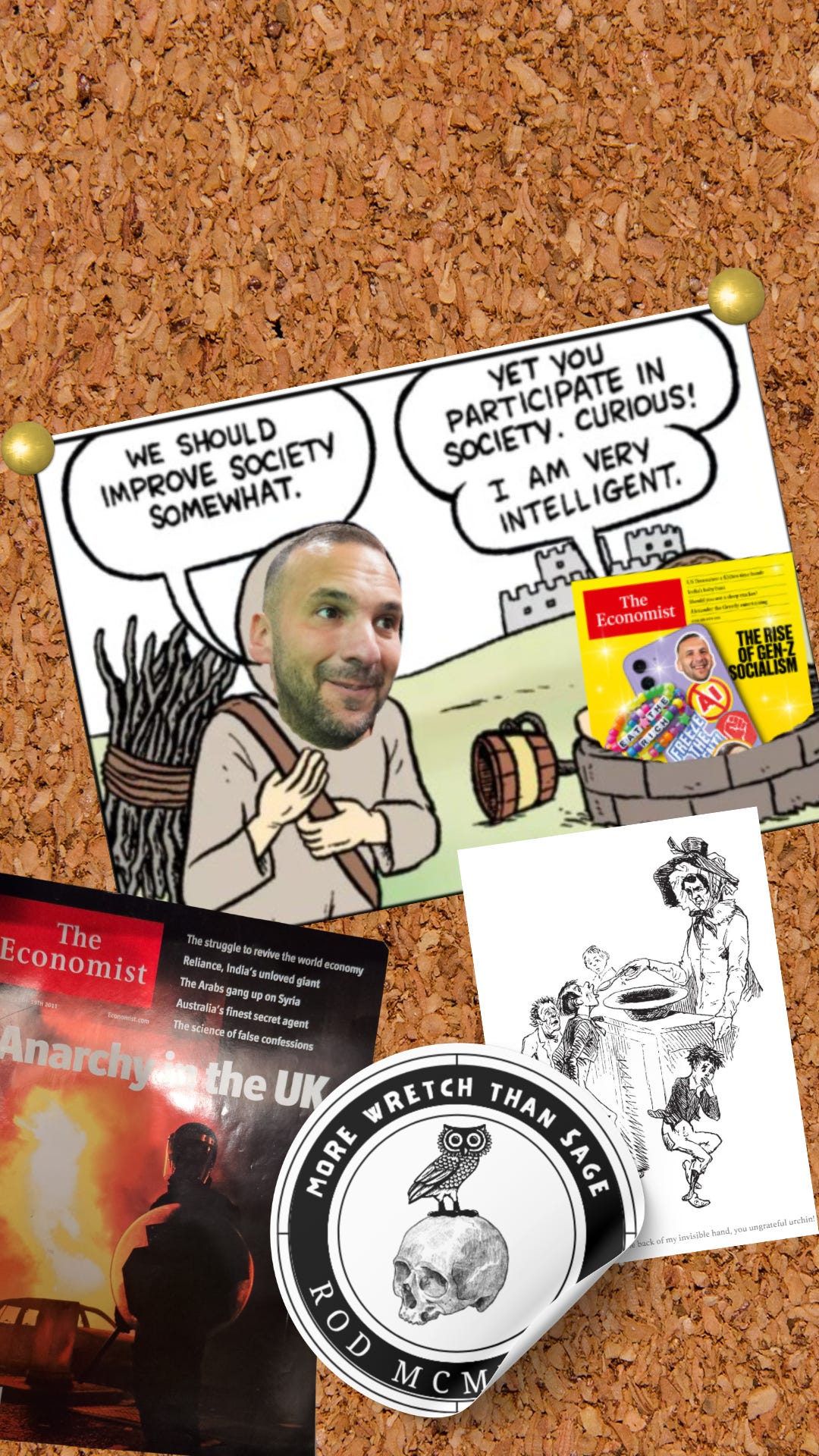
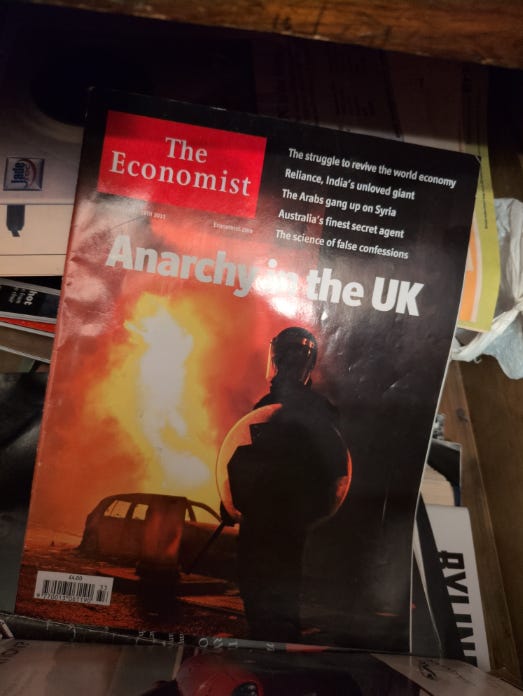
The first was this “Anarchy in the UK” edition from 2011, filed away in research for a book I’m still writing on civil unrest, and last thumbed through when writing about the causes of civil unrest for Byline Times in 2024. The second is their current effort, “The Rise of Gen-Z Socialism”1, where they frame a shift with wide support as a generational tantrum. OK Boomer.
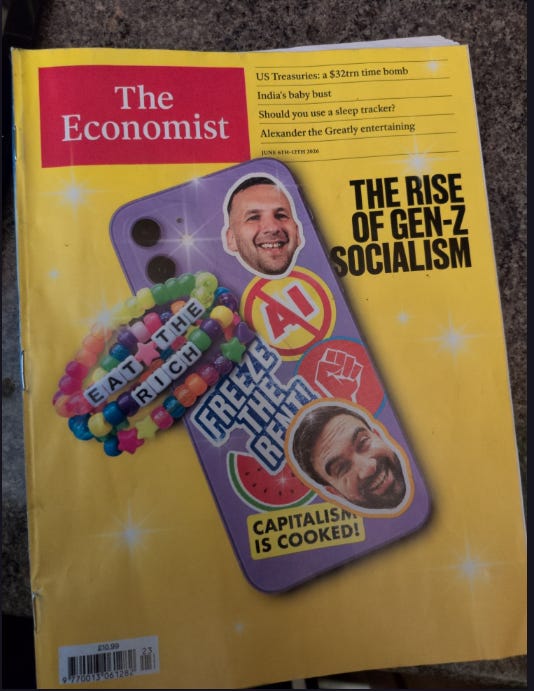
First, I’m a sucker for a good cover, and I thought this one did a good job. It’s also interesting to note that while their print edition leads with a fairly neutral “The Rise of Gen-Z Socialism”, their online version has the rather more on-the-nose “How to fight back against Gen-Z socialism”

On reading the article, they sound a little worried.
The article identifies a new generation of socialists gaining ground across the democratic world. Its cast includes Zohran Mamdani in New York, Zack Polanski and the Greens in Britain, Avi Lewis in Canada, and Jean-Luc Mélenchon in France.
Readers as pedantic as I am will already have picked up that none of these politicians is Gen-Z. Generally, Gen Z is considered those born between around 1997 and the early 2010s. Mamdani was born in 1991; Zack Polanski was born in 1982, making him firmly an elder millennial; Avi Lewis, born in 1967, is Generation X; Mélenchon, born in 1951, is firmly in Boomer territory.
They acknowledge this and defend the demographic label thus -
“Not because all its adherents are young but because it is the brand of leftism made for the TikTok era”
- God forbid politicians have policies that appeal to younger voters, and the communication nous to reach them.
Even at face value, that label is misleading.
Mamdani won three-quarters of voters aged 18–29, yet those voters made up only 11 per cent of ballots, meaning the great majority of his total support came from older voters.2
Polanski’s Greens poll best among 18–24s, but also draw considerable support from voters aged 25–49.3
Mélenchon’s appeal is strongest among the young4 …but Ipsos still recorded him at 22 per cent among 35–60s in 2022.5
The Economist is wrong to frame this as a Gen-Z revolt against prosperity. A TikTok trend dressed up as political economy. This is not “Gen-Z socialism” in any literal demographic sense. It is cross-generational economic discontent, with the audacity to resonate with the genuine concerns of younger voters.
Isn’t that what good politics should do?
Doing it for the kids
Every generation, famously, tends to think the next generation is ruining society!6 By casting these policies as a TikTok tantrum from kids who know no better, this could, functionally, serve to discredit the policies by playing on prejudices against those who support them.
Their location of Gen-Z-Socialism is broadly the developed world, but its emotional centre is unmistakably urban, young, precarious and priced out. Its timing is after inflation, during the ongoing Genocide in Gaza, after the housing squeeze, after the normalisation of billionaire, and now trillionaire, wealth, after a decade and a half in which workers of all ages have been told to work hard while asset prices sprinted away from salaries.
That this has hit younger voters particularly hard is a fair assessment - It’s simple: voters, many of them young, are angry because the settlement they inherited is failing them. That anger is being translated into demands for rent controls, public ownership, wealth taxes, universal services and a more democratic economy. That the policies win support even from those who may not be in as dire straits shows it is not a me-first philosophy, but an empathy-first one.
But The Economist clutches its pearls that this must be resisted because it threatens ‘prosperity’. ( Prosperity for whom exactly?) Their argument frames the material self-defence of a livable cost of living as selfishness, treats surveillance-capitalism’s outcomes as natural, and casts grassroots democratic intervention as distortion. It ignores the political consequences of concentrated wealth, caricatures socialist policy as crude state command, and underplays the on-the-ground reality.
The appeal of Mamdani, Polanski et al. is that they propose changing a political economy that has asked young people to worship markets while denying them homes, security, public services, and a livable future, and their opposition is broadly ‘more of the same or worse’.
The chutzpah to defend capitalism by attacking demands for more equality as a “me-first doctrine” is incredible. That phrase is doing a lot of ideological work. The article concedes that inflation, rent, housing, artificial intelligence and public services are real concerns, but then recasts political demands to fix them as some sort of generational consumer tantrum of the selfish, rather than a valid response to injustice.
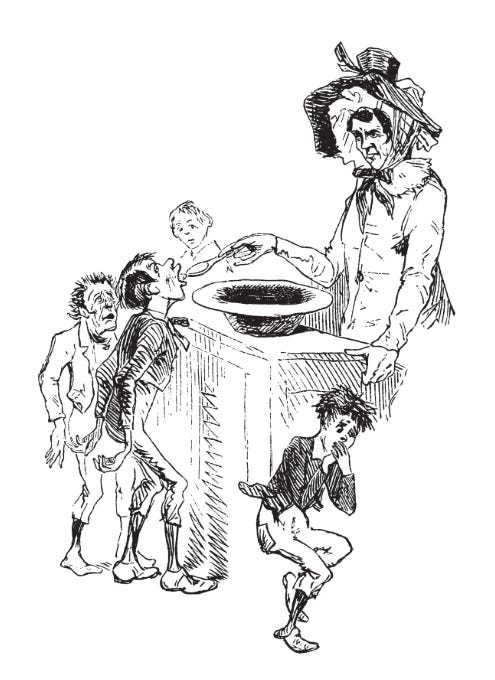
Their rationale would condemn Oliver Twist’s request for more gruel as ‘me-first’ without questioning the workhouse-orphanage system that leaves him hungry.
Housing security is not an indulgence. The OECD reported in 2024 that across OECD countries, 60 per cent of people aged 18 to 29 were somewhat or very concerned about finding and maintaining adequate housing, compared with 49 per cent of those aged 30 to 54 and 38 per cent of those aged 55 to 64.7

In Britain, the Resolution Foundation has shown that home ownership among 25 to 34-year-olds remains far below the levels enjoyed by previous generations.8
Housing is the foundation from which people form families, take jobs, build communities, and generally participate in civic life. When a generation cannot afford rent, cannot save for a deposit, and cannot assume that work will lead to security, it is not “me-first” to ask cui bono? from the system.
Their lead treats the left’s focus on rent, public services and household costs like demands for more smashed avocado toast. A more persuasive reading is that these issues are where abstract political economy becomes daily life. Marx’s language of class struggle may seem old-fashioned to market liberals, but the conflict between asset owners and wage earners is not an antique. It is visible every month when tenants transfer half their income to landlords whose wealth rises while their own prospects shrink.
The lead makes the tired old claim - the assumption that capitalism’s successes belong to free markets, while capitalism’s failures are accidents to be tidied up by better policy, and underwritten by these same rent-squeezed voters.
The Economist praises “private enterprise” as being “at the root of human prosperity” and credits free trade and globalisation with record incomes, longer lives and reduced extreme poverty. There is truth in parts of that story. Trade, technology and investment have helped raise living standards. By some measures, extreme poverty has fallen dramatically since 1990, especially in East and South Asia.9 But the article turns a complex history into a multinationalist millionaire morality play in which markets create wealth and states threaten it.
That is historically thin. Modern prosperity has always been a mixed achievement of markets, states, labour movements, public science, infrastructure, law, education, health systems and industrial policy.
The internet, pharmaceuticals, aviation, railways, energy grids and semiconductors did not emerge from pure market spontaneity. They emerged from dense ecosystems of public funding, private enterprise and state coordination.
Mariana Mazzucato argues that the state has often been an entrepreneurial risk-taker, funding early-stage innovation that private capital later commercialises.
“There is indeed lots of talk of partnership between the government and private sector, yet while the efforts are collective, the returns remain private. Is it right that the National Science Foundation did not reap any financial return from funding the grant that produced the algorithm that led to Google’s search engine?”
Marina Mazzucato - The Entrepreneurial State: Debunking Public vs. Private Sector Myths 10
Mazzucato goes on to share a more deadly example from Vallas, Kleinman and Biscotti11 around pharmaceutical development, which I feel horrifyingly sums up the whole damn game.
“Taxpayers who financed the development of (the new drug) cannot obtain it for their family members because they cannot afford (The $350,000 cost)”
Karl Polanyi made the observation decades ago: market society is politically constructed. Land, labour and money had to be turned into commodities through law and state power.12
Market-based societies, then, are not inevitable but historically contingent. The “free market” is therefore not the absence of politics. It is one political settlement chosen from among others. It is not inevitable, nor inescapable.
“We live in capitalism. Its power seems inescapable. So did the divine right of kings. Any human power can be resisted and changed by human beings. Resistance and change often begin in art, and very often in our art, the art of words.”
―Ursula K. Le Guin
In this, the centenary year of the 1926 British General Strike13, the article fails to address, or even ask, how much of falling poverty and rising cost of living has come not from Captialism, but from the reaction against capitalism’s harms - Things like the weekend, The 8 hour day, Health and Safety, Paid Holidays, minimum wages… these are all more directly beneficial to individual workers, and they were not the inevitable consequence of the invisible hand, but hard-won bites back against it.
(BTW If you are not familiar with the 1926 General strike and its lessons for 2026, then do please check out this recent edition from New Internationalist Magazine!)

Commerce pre-dates capitalism. If markets are made, they can be remade. If property rights, corporate governance, tax rules and labour laws are political choices, then democratic change is not an assault on economic reality. It is a demand that economic rules be made more answerable to democratic ends.
The Economist wants to defend free-market capitalism while admitting that housing, infrastructure, pensions, taxation and AI all need political intervention. In doing so, it quietly concedes the very premise it is trying to defeat: that the economy is too important to be left in the hands of only those who benefit from it.
The article has anadasmophobia - a fear of redistribution. It warns that these movements believe “spending can be paid for by the richest”, and it treats wealth taxes as likely to become “confiscatory” and hostile to innovation. That is a familiar liberal anxiety. Surely things being paid for by the richest makes more sense than them being paid for by the poorest, while the rich get richer. At best, if this argument was ever formulated in good faith, it was at a time of lesser inequality.
The World Inequality Report 2022 found that the richest 10 per cent of the global population receive 52 per cent of global income, while the poorest half receive just 8.5 per cent.14 The same report documents the extreme concentration of wealth and the declining public share of wealth in many countries.
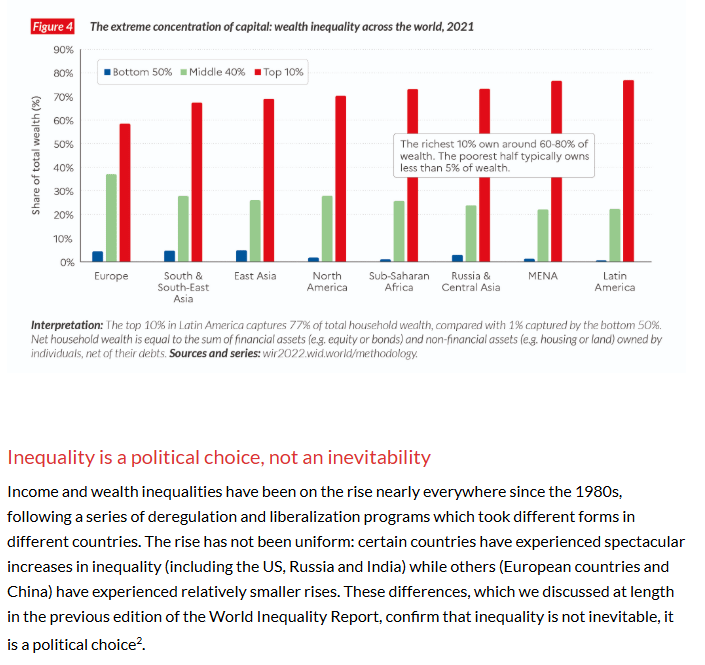
In other words, the political problem is not that socialists have become obsessed with billionaires. The problem is that capitalism has.
Inequality is not merely unjust but economically damaging. An IMF staff discussion note by Jonathan Ostry, Andrew Berg and Charalambos Tsangarides found that lower net inequality is robustly associated with faster and more durable growth, and that redistribution, except in extreme cases, does not appear to have the damaging growth effects often claimed for it.15

This directly challenges the article’s implicit model. The magazine imagines growth first, maybe distribution later. But if high inequality damages social trust, political stability, human capital and aggregate demand, then redistribution must be part of the growth model itself.
Wealth taxation is more difficult than income taxation. Valuation, avoidance, liquidity, loopholes and international mobility are real design problems - though some may consider them to be features rather than bugs. But difficulty is not refutation. The OECD’s own work on net wealth taxes treats them as a policy instrument with trade-offs, not as an economic impossibility.16
Gabriel Zucman’s 2024 report for the Brazilian G20 presidency estimated that a coordinated 2 per cent minimum tax on global billionaires could raise $200 billion to $250 billion a year from around 3,000 taxpayers.17

That is not a complete fiscal programme, and it would require international cooperation. But it makes The Economist’s language of inevitable confiscation look more like class reflex than analysis.
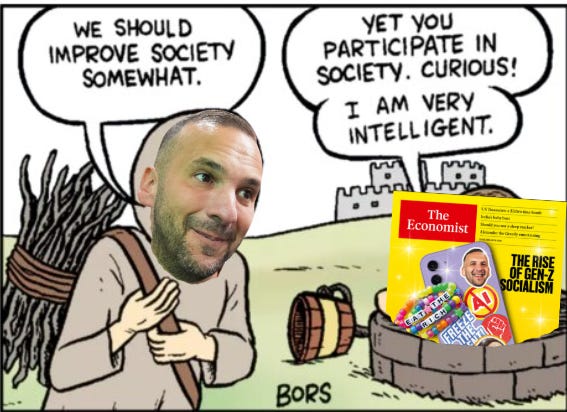
The article’s tired caricature of socialist policy as “state diktat” imagines chunks of everyday life, “from housing to groceries”, governed by command. This is an old bait-and-switch: describe democratic economic intervention in the language of authoritarian control, then announce that freedom is in danger.
Yet the policies associated with the new democratic left are not commands to abolish all markets. They are attempts to decommodify essential services and deliver better on Maslow’s hierarchy of needs.
There is a large difference between a police state allocating bread and a democratic government making buses free, building social housing, taxing land value, regulating rents, expanding childcare, bringing failing utilities into public ownership, giving workers more power inside firms, or helping people put food on the table.
Universal healthcare, public education, libraries, pensions, minimum wages and social housing are not alien intrusions into civilisation. They are civilisation’s achievements. They are the justification for civilisation and what offsets some of the damage it does.
Britain’s NHS, for all its current strain, embodies a principle that market liberalism has never morally surpassed: need outranks ability to pay. The same is true of economic democracy. Worker co-operatives, sectoral bargaining, trade unionism, employee ownership, municipal enterprise and public-interest utilities all challenge the idea that private shareholder control is the natural form of economic life. They are practical institutional forms, not adolescent slogans.
The Italian co-operative alliance, the Mondragón federation in Spain, German co-determination and Nordic collective bargaining traditions - and my employers, the non-profit media co-operative New Internationalist, all show that capitalism itself has always contained struggles over power, voice and ownership. The question is not whether the state controls everything or the market controls everything. The real question is who gets power over the conditions that impact our lives.
The Economist misunderstands why these policies and politicians are becoming attractive. It writes as if young voters have forgotten capitalism’s achievements. A better explanation is that they have experienced its broken promises.
Gallup found in 2025 that only 54 per cent of Americans viewed capitalism positively, down from 60 per cent in 2021, while 39 per cent viewed socialism positively. Among Democrats, socialism was viewed more favourably than capitalism, by 66 per cent to 42 per cent.18
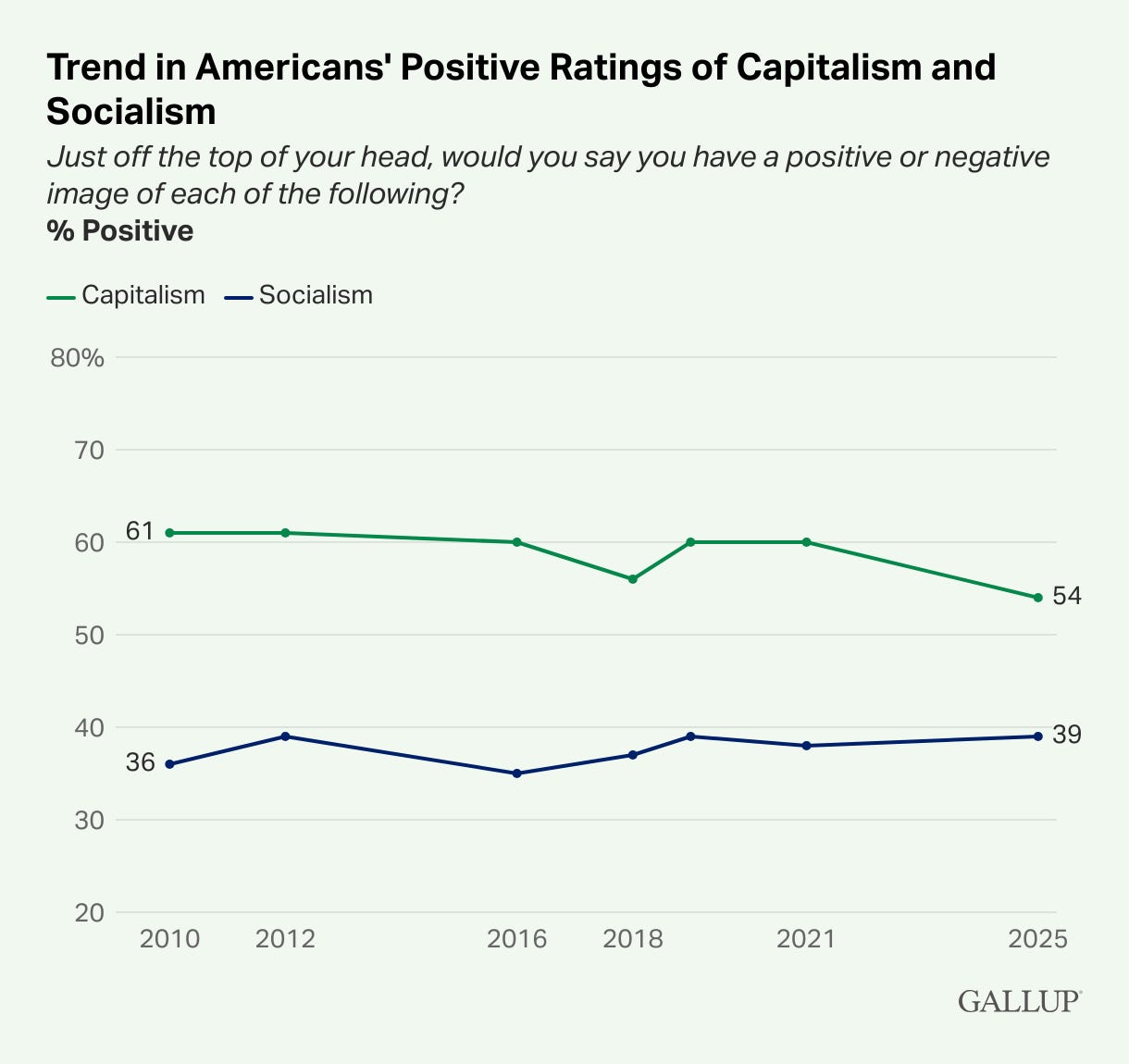
In Britain and other English-speaking countries, polling has similarly found growing and strong support for socialism among younger adults.19 These numbers do not prove that young people have all become Marxists. They prove that the word “capitalism” no longer carries the automatic promise of a rise in living standards it once did, not a promise that was always kept, but one that had enough of a razzle-dazzle of verisimilitude.
“What isn’t good for the hive, isn’t good for the bee.”
Marcus Aurelius
This Stoic quote is a reminder of the self-interest of empathy. The rising support of redistributive policies such as rent controls across a broad church of generations and demographics reflects the humanitarian belief that even if a voter doesn’t directly benefit themselves, they benefit from living in a society where people can afford to eat, to live, to learn. Not “Me first”, but us together.
This loss of legitimacy cannot be mysterious. Young people entered adulthood after the financial crisis, austerity, tuition-fee escalation, wage stagnation, climate breakdown, pandemic disruption, rent inflation and now AI anxiety.
They were told that the market rewards effort, only to watch inherited wealth matter more than work.
They were told that globalisation would make everyone richer, only to see deindustrialised towns, fragile supply chains, and billionaires buying political influence.
They were told that politics must be fiscally responsible, only to see states create enormous rescue packages when banks, corporations, or asset markets were in danger.
The lesson many learned was not that public power is impossible. The lesson was that public power is usually reserved for the powerful.
It’s trickle-up economics.
The article makes the broad claim that “Rent controls would worsen housing shortages by crushing the incentive to build”. Rent controls can reduce supply when they are crude, permanent and detached from a wider housing strategy. They can deter construction, encourage landlords to sell, and leave new renters facing higher prices in an uncontrolled sector. But that is an argument for careful design, exemptions for new construction, workable repair and cost-recovery rules, effective enforcement, and above all a serious programme of social and affordable housebuilding. It is not an argument that tenants must simply absorb whatever rent increases a dysfunctional market can impose.
But the SQUASH campaign points out there are hundreds of thousands of empty properties in the UK. Lack of new housing is not the only variable.

The solutions, like the problems, aren’t even new. Civilisations have been setting rules around food, land, labour and debt for millennia because leaving essentials entirely to whoever holds the most power has never been politically neutral. Forms of minimum wage and rental caps date back at least to the Code of Hammurabi.20
The worldview of The Economist is elegant, but blinkered. It believes in open markets, private enterprise, competition, growth and restrained state intervention. At its best, that tradition defends civil liberty, pluralism, trade and the dynamism of innovation.
At its worst, it mistakes the freedom of capital for freedom itself.
It shines a spotlight on the danger of excessive state power (and I’m no fan of excessive state power) but turns a blind eye to the danger of excessive private power. It worries about bureaucrats setting prices but is less alarmed by landlords setting rents, corporations setting wages, platforms setting speech rules, or billionaires setting the terms of political debate.
It fears the visible hand of democratic government more than the invisible coercion of economic dependence. Of course, some price controls can create shortages. Badly designed rent controls can reduce supply. Indeed, this speaks to why The Economist was founded in 1843, in opposition to the Corn Laws - British protectionist Grain Tarrifs that were keeping food more expensive and protecting the elite to the detriment of the workers. Its answer then as now was more laissez-faire free trade - but at least its founding campaign understood that the affordability of basic necessities was a critical political question.
Nationalisation can be bureaucratic or complacent. Public spending can be wasteful. Wealth taxes can leak if enforcement is weak… these are only arguments for better policy design, not surrender. A rent policy that caps increases within tenancies while exempting new construction is different from a blanket freeze. Public ownership with democratic accountability and professional management is different from ministerial micromanagement. A universal basic service is different from a vague promise of free everything. The impossibility of perfection is not an argument against doing better.
Any equally critical examination of **Waves hands around generally** Enron, the 2008 crash, sewage-dumping water companies, exploitative landlords, opioid profiteering, the world’s first trillionaire and a thousand other examples make a stronger case against the status quo than these hypothetical risks of intervention make against change.
The optimistic case is therefore not that these movements are automatically right about every policy, but that they are at least trying to address some of the right problems.
Among these are fundamental questions faced by every civilisation: What is the economy for? Who owns the wealth that society creates? Which goods should be allocated by price, and which by need? How much inequality can democracy survive? And why should the young accept permanent insecurity in societies rich enough to abolish it?
Far from being childish, these are core questions that democracies must confront, and they are often the very problems that populism - also making inroads with working class voters - seeks to scapegoat. The appeal of these new politicians with old policies lies in their speaking to the reality of voters rather than textbook theory as TikTok trend.
It looks at a world of high productivity, extraordinary wealth, technological capacity, and ecological collapse, and asks why so many people are still exhausted, indebted, insecure, and afraid. It looks at private abundance beside public decay and refuses to call that balance efficient or fair. It looks at market liberalism’s promise that growth will trickle down tomorrow and replies that tomorrow never comes.
Peter Kropotkin’s ‘Conquest of Bread’ made much the same argument in 1892.
“In our civilised societies we are rich. Why then are the many poor? Why this painful drudgery for the masses? Why, even to the best paid workman, this uncertainty for the morrow, in the midst of all the wealth inherited from the past, and in spite of the powerful means of production, which could ensure comfort to all, in return for a few hours of daily toil?
…It is because all that is necessary for production – the land, the mines, the highways, machinery, food, shelter, education, knowledge – all have been seized by the few in the course of that long story of robbery, enforced migration and wars, of ignorance and oppression, which has been the life of the human race before it had learned to subdue the forces of Nature.It is because, having reduced the masses to a point at which they have not the means of subsistence for a month, or even for a week in advance, the few can allow the many to work, only on the condition of themselves receiving the lion’s share. It is because these few prevent the remainder of men from producing the things they need, and force them to produce, not the necessaries of life for all, but whatever offers the greatest profits to the monopolists.”
Peter Kropotkin - The Conquest of Bread21
The support for Mamdani, Polanski and Mélenchon is strongest among younger voters because they have been hit first and hardest by insecure work, impossible housing costs, crumbling public services and a future increasingly sold off for parts. But it reaches well beyond them. It is a cross-generational recognition that an economy cannot call itself successful while so many of the people who make it run cannot afford security, dignity or a stake in the future. The demand is not for state diktat, nor for the abolition of every market, but for democratic control over the things on which life depends.
The future worth fighting for is not a grey command economy, nor a nostalgia tour through twentieth-century state socialism. It is a democratic economy in which markets are tools, not masters; wealth is taxed because society helped create it; housing and food are treated as human necessity; work carries power as well as pay; and public goods are recognised as the foundation of private flourishing.
Notes
The Economist, “The Rise of Gen-Z Socialism,” The Economist, June 6, 2026,
Medina, Alberto, Sara Suzuki, and Ruby Belle Booth. “Young Voters Power Mamdani Victory, Shape Key 2025 Elections.” CIRCLE, November 5, 2025. https://circle.tufts.edu/latest-research/young-voters-power-mamdani-victory-shape-key-2025-elections
YouGov. “How Would Britain Vote at the Start of 2026?” January 21, 2026. https://yougov.com/en-gb/articles/53923-how-would-britain-vote-at-the-start-of-2026
Pineau, Elizabeth. “In France’s Poor, Diverse Suburbs, Melenchon’s Hard Left Charts a Path to the Presidency.” Reuters, June 2, 2026. https://www.reuters.com/world/frances-poor-diverse-suburbs-melenchons-hard-left-charts-path-presidency-2026-06-02/
Ipsos. “Présidentielle 2022 | Profil des abstentionnistes et sociologie des électorats.” April 10, 2022. https://www.ipsos.com/fr-fr/presidentielle-2022/1er-tour-abstentionnistes-sociologie-electorat
Aastha Raj, “Psychology Says Every Generation Secretly Believes the Next One Is ‘Ruining Society’: From Baby Boomers to Gen Z, Here’s Why It Keeps Happening,” The Economic Times, May 18, 2026, https://economictimes.indiatimes.com/news/international/us/psychology-says-every-generation-secretly-believes-the-next-one-is-ruining-society-from-baby-boomers-to-gen-z-heres-why-it-keeps-happening/articleshow/131074794.cms
OECD, “Affordable Housing,” in Society at a Glance 2024 (Paris: OECD Publishing, 2024), https://www.oecd.org/en/publications/society-at-a-glance-2024_918d8db3-en/full-report/affordable-housing_1a2ec30f.html
Resolution Foundation, Housing Hurdles: Recent Trends in Young People’s Housing Circumstances (London: Resolution Foundation, December 20, 2024), https://www.resolutionfoundation.org/publications/housing-hurdles/
World Bank, “Poverty,” accessed June 12, 2026, https://www.worldbank.org/ext/en/topic/poverty
Mariana Mazzucato, The Entrepreneurial State: Debunking Public vs. Private Sector Myths (London: Anthem Press, 2013)
Vallas SP, Kleinman DL and Biscotti D, ‘Political structures and the making of US biotechnology’ in Block and Keller (eds), State of Innovation
Karl Polanyi, The Great Transformation: The Political and Economic Origins of Our Time (Boston: Beacon Press, 2001; first published 1944).
New Internationalist. “General Strike!” New Internationalist, no. 561, May–June 2026. https://newint.org/issues/2026/05/21/general-strike
Lucas Chancel et al., World Inequality Report 2022 (Paris: World Inequality Lab, 2021), executive summary, https://wir2022.wid.world/executive-summary/
Jonathan D. Ostry, Andrew Berg, and Charalambos G. Tsangarides, Redistribution, Inequality, and Growth, IMF Staff Discussion Note SDN/14/02 (Washington, DC: International Monetary Fund, 2014), https://www.imf.org/external/pubs/ft/sdn/2014/sdn1402.pdf
OECD, The Role and Design of Net Wealth Taxes in the OECD (Paris: OECD Publishing, 2018), https://www.oecd.org/en/publications/the-role-and-design-of-net-wealth-taxes-in-the-oecd_9789264290303-en.html
Gabriel Zucman, A Blueprint for a Coordinated Minimum Effective Taxation Standard for Ultra-High-Net-Worth Individuals (report commissioned by the Brazilian G20 presidency, June 25, 2024), https://gabriel-zucman.eu/files/report-g20.pdf
Jeffrey M. Jones, “Image of Capitalism Slips to 54% in U.S.,” Gallup, September 8, 2025, https://news.gallup.com/poll/694835/image-capitalism-slips.aspx
Fraser Institute, “New Poll Finds Strong Support for Socialism in the U.K.,” March 24, 2023, https://www.fraserinstitute.org/commentary/new-poll-finds-strong-support-socialism-uk
Hammurabi. The Code of Hammurabi. Translated by Robert Francis Harper. Wikisource. Accessed June 19, 2026. https://en.wikisource.org/wiki/The_Code_of_Hammurabi_(Harper_translation)
Peter Kropotkin, Anarchist Communism, extracted from the revised 1913 text of The Conquest of Bread (London: Penguin Classics, 2020)page 4
https://www.pangram.com/history/f3320f14-d50f-4f78-ba55-42eb0ee17c08?ucc=x8otV8eNKph